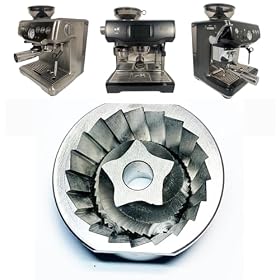
Best Grinder Upgrade Before Buying a More Expensive Machine
Before spending more on an espresso machine, check whether your grinder is limiting shot quality. A capable burr grinder can improve grind consistency, dialing-in control, and flavor more than a machine upgrade in many home setups.
Best grinder upgrade before buying a more expensive machine
If your espresso tastes inconsistent, the grinder is often the better first upgrade. A more capable grinder can produce a narrower, more adjustable grind that makes it easier to dial in espresso, while a more expensive machine cannot fully compensate for uneven grounds. Upgrade the machine first only when it has a clear limitation, such as unstable temperature, inadequate pressure control, poor steam performance, or a failing brew system.
Why the grinder often matters more
Espresso requires a precise grind. Small changes in particle size affect how quickly water flows through the puck, so an inconsistent grinder can produce a mixture of overextracted and underextracted flavors in the same shot.
Fewer sour, bitter, or weak shots caused by uneven grinding
More useful feedback when you change one brewing variable at a time
A machine controls water delivery, temperature, pressure, and steaming. Those features matter, but they cannot make poorly ground coffee uniform. If your grinder produces clumps, wide grind steps, or too many fines and boulders, a machine upgrade may deliver less improvement than expected.
Signs your grinder should be upgraded first
A grinder is the likely bottleneck when several of these describe your setup:
You cannot make small enough adjustments to move from fast shots to slow shots.
The same dose and settings produce noticeably different results.
Espresso is often sour and bitter at the same time.
The grinder struggles to produce a fine enough setting without choking or stalling.
Grounds are visibly clumpy or vary substantially in particle size.
The adjustment mechanism shifts during grinding.
Retained grounds from an earlier coffee noticeably affect the next dose.
Changing beans requires a frustrating amount of purging and recalibration.
Some variation is normal. Coffee freshness, dose distribution, tamping, and machine temperature also affect results. But if you cannot make a repeatable grind adjustment, those other variables become difficult to evaluate.
Product prices and availability are accurate as of the date/time indicated and are subject to change. Any price and availability information displayed on Amazon.com at the time of purchase will apply to the purchase of this product.
What to look for in an espresso grinder
Burr design and alignment
For espresso, a burr grinder is generally preferable to a blade grinder because it gives you more control over particle size. Burr size alone does not determine performance, however. Burr geometry, alignment, motor control, and adjustment design also affect the result.
Look for a grinder intended to handle espresso rather than one marketed only for coarse brew methods. A grinder that can produce espresso-fine grounds is not automatically good at producing them consistently.
Fine adjustment control
Espresso often needs very small grind changes. Stepped grinders can work well if their steps are close enough for your coffee and basket, while stepless adjustment offers finer control but may be less convenient to return to a previous setting.
If you switch between espresso and drip coffee, consider how easily the grinder can move between settings and return to an espresso setting. For espresso-only use, a dedicated adjustment range may be simpler.
Dosing method and retention
Choose between two common workflows:
Hopper dosing: Keep beans in a hopper and grind a dose when needed. This is convenient for frequent use and repeated shots.
Single dosing: Weigh beans before grinding. This can make switching coffees easier and helps you control the exact dose, but it may require more manual steps.
Low retention can reduce waste and make switching coffees easier, but retention claims are not always directly comparable between designs. The grinder's workflow matters as much as its stated retention.
Motor and heat management
A grinder used for one or two home shots at a time has different demands from one used for several drinks in succession. Consider duty cycle, cooling, and whether the manufacturer specifies limits for continuous use. Avoid assuming that a larger motor automatically produces better espresso.
Ease of cleaning and adjustment
A grinder that is difficult to clean may gradually accumulate old coffee, oils, and fines. Look for access to the burrs and a way to restore the adjustment after cleaning. Follow the manufacturer's instructions, and unplug the grinder before opening or servicing it.
Product prices and availability are accurate as of the date/time indicated and are subject to change. Any price and availability information displayed on Amazon.com at the time of purchase will apply to the purchase of this product.
Grinder types that make sense for different users
Dedicated espresso grinder
This is usually the most direct upgrade for someone who makes espresso regularly. The adjustment range and dosing workflow are designed around fine grinding, which can make dialing in less frustrating.
Choose this route when espresso is your primary drink and you want the simplest path to more consistent shots.
Single-dose grinder
A single-dose design is useful if you rotate through several coffees, buy small amounts of beans, or want to control each dose by weight. It may be less convenient if you make many drinks in a row and prefer a hopper workflow.
Choose it when flexibility and coffee switching matter more than speed.
Grind-on-demand hopper grinder
A hopper grinder can be convenient for households that use the same beans repeatedly. It is a practical choice when you want a fast, repeatable routine and do not need to change coffees often.
Choose it when convenience and throughput are more important than switching between beans.
Product prices and availability are accurate as of the date/time indicated and are subject to change. Any price and availability information displayed on Amazon.com at the time of purchase will apply to the purchase of this product.
Grinder specifications that should not be overvalued
Some specifications are useful, but none should be considered in isolation.
Burr diameter: Larger burrs may support faster grinding or different designs, but size alone does not guarantee better espresso.
Motor wattage: More watts do not necessarily mean a more uniform grind.
Number of settings: A high setting count may still provide poor usable control if the adjustment range is concentrated elsewhere.
Grinding speed: Faster is not always better if the workflow creates more heat, mess, or retention.
Static and clumping claims: These depend on coffee, humidity, dose, and technique as well as grinder design.
Prioritize usable adjustment, repeatability, serviceability, and a workflow you will actually follow.
When the espresso machine really should come first
Upgrade the machine before the grinder when the machine has a fundamental limitation that affects your goals. Examples include:
It cannot maintain a suitable brewing temperature consistently.
The brew pressure or water delivery is clearly malfunctioning.
You need better steaming performance for milk drinks.
The portafilter or basket size limits the accessories and recipes you want to use.
The machine lacks a feature you specifically need, such as simultaneous brewing and steaming.
It leaks, trips a breaker, fails to heat, or has another repair issue.
Do not buy a grinder as a substitute for a machine that is unsafe or failing. Unplug a malfunctioning machine and follow the manufacturer's service guidance. Electrical repairs and internal pressure-system work should be handled by a qualified professional when you are not specifically trained to perform them.
A sensible upgrade order
For many home setups, this order works well:
Use fresh beans and confirm the machine is clean and functioning normally.
Improve the grinder if grind adjustments are coarse, inconsistent, or unsuitable for espresso.
Improve puck preparation with a consistent dose, distribution, and tamp.
Replace worn or poorly matched baskets or portafilters if needed.
Upgrade the machine when its temperature, steaming, workflow, or reliability limits your goals.
A grinder upgrade is most valuable when you also learn to dial in. Start with a consistent dose, adjust grind size to control flow, and change one variable at a time. Keep the machine's brew ratio and temperature approach consistent while comparing results.
Bottom line
For most home espresso users whose machine is functioning correctly, a capable espresso grinder is the better first investment than a more expensive machine. Look for consistent fine grinding, small usable adjustments, a suitable dosing workflow, and easy cleaning rather than choosing by burr size or motor wattage alone. Move to a machine upgrade when the machine itself—not the grind—is the limiting factor.
FAQ
Can a better grinder make a cheap espresso machine produce better coffee?
Yes, if the machine is operating normally. A better grinder can make shots more consistent and easier to dial in, although it cannot fix unstable temperature, poor water delivery, damaged seals, or other machine limitations.
How much should I spend on a grinder before upgrading my espresso machine?
There is no universal spending threshold. Choose a grinder that offers consistent espresso grinding, usable fine adjustment, and a workflow you can repeat. The right capability matters more than matching a particular machine-to-grinder price ratio.
Is a single-dose grinder better for espresso?
Not automatically. Single dosing is useful for switching beans and weighing every dose, while a hopper grinder may be faster and more convenient for repeated drinks with the same coffee. Choose based on your routine.
Do I need a grinder with stepless adjustment for espresso?
No. Stepped adjustment can work well when the steps are close enough for your coffee and basket. Stepless adjustment provides finer control but can be harder to track and return to after cleaning or switching coffees.