Bottomless Portafilter as an Upgrade: Benefits, Fit, and Tradeoffs
A bottomless portafilter can make puck preparation problems easier to see, but it does not automatically improve espresso. Learn when it is worth buying and how to choose a compatible one.
What do you need help with?
Open an answer, or tell us what we should cover next.
Answered in this guide
Decide whether a bottomless portafilter is worth buying
It is worthwhile mainly for seeing extraction problems and improving puck preparation. It will not automatically make better espresso, and spraying or fit issues may make it less convenient.
Understand how a bottomless portafilter changes brewing
A bottomless portafilter removes the spouts and exposes the basket, making channeling and uneven extraction easier to see while brewing instead of hiding those problems until tasting.
Choose a bottomless portafilter that fits your machine
Match the portafilter to the machine’s group-head standard and locking-tab layout, then check the basket, handle clearance, cleaning needs, and basket fit before buying.
Spraying, fast flow, or worse-tasting espresso can come from uneven grounds, clumps, puck cracks, overfilling, or a dose that does not suit the basket.
Request a topic and help us choose what to build next.
Build a complete puck-preparation routine to prevent channeling
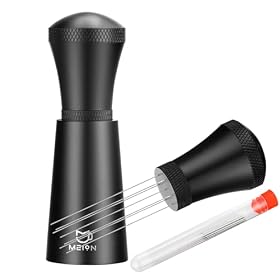
Choose a WDT tool and calibrated tamper for better puck prep
Clean and maintain a bottomless portafilter
Requests help us prioritize the next guide. No email required.
One anonymous request per topic.
Bottomless portafilter as an upgrade
A bottomless portafilter can be a useful upgrade if you want to diagnose espresso extraction and improve your puck-preparation technique. It removes the lower spouts, exposing the bottom of the filter basket while the shot runs. That visibility can reveal channeling, uneven distribution, or an incorrect grind—but it will not fix those problems by itself.
For many home baristas, the upgrade makes sense after the machine’s stock portafilter is working properly and you are ready to refine your workflow. It is less useful if you mainly want a cleaner, easier shot or if your machine uses a nonstandard portafilter size.
What a bottomless portafilter changes
A standard portafilter directs brewed espresso through one or two spouts. A bottomless, or naked, portafilter leaves the basket exposed. Espresso exits directly from the underside of the basket and flows into the cup.
This changes the feedback you get from a shot:
An even, centered flow usually suggests reasonably consistent puck preparation.
A thin stream that starts from one area can indicate uneven distribution or channeling.
Spraying or spurting often points to cracks, voids, damaged coffee clumps, or an overloaded basket.
Flow that begins too quickly across much of the basket may indicate a grind that is too coarse, too little coffee, or insufficient resistance from the puck.
These signs are clues rather than exact diagnoses. Grind size, dose, basket shape, coffee freshness, machine pressure, and tamping technique all affect the result.
The main benefits
Better visibility into extraction
The biggest advantage is that you can see what is happening under the basket. With a spouted portafilter, channeling may be hidden until you taste a sour, bitter, or thin shot. A bottomless model can show the problem while the shot is running.
Easier workflow for some setups
A bottomless portafilter usually has more clearance underneath than a spouted version. That can make it easier to place a scale and cup beneath the group head, especially when the machine has limited vertical space.
A simple way to improve technique
Because flaws are visible, a bottomless portafilter can encourage more consistent dosing, distribution, and tamping. It is best viewed as a diagnostic tool and workflow upgrade—not as a device that increases pump power or automatically produces better crema.
Fewer parts to clean
Without spouts and internal channels, there are fewer areas where coffee residue can collect. The basket and portafilter still need regular rinsing, but the design can be simpler to inspect and clean.
Product prices and availability are accurate as of the date/time indicated and are subject to change. Any price and availability information displayed on Amazon.com at the time of purchase will apply to the purchase of this product.
Important tradeoffs
It can spray
A bottomless portafilter may spray hot espresso if the puck channels. Keep your face and hands away from the basket during brewing. Use a cup with enough room and avoid making adjustments while the pump is running.
If spraying is frequent, focus on puck preparation rather than assuming the portafilter is defective. A more even distribution, suitable dose, and appropriate grind are usually the first things to check.
It exposes technique problems
A bottomless portafilter can make shots look worse before they get better. Spurting and uneven flow are often signs that the machine’s existing setup or preparation routine needs attention.
It may not fit your machine
Portafilter compatibility is not determined by the machine brand alone. You need to match details such as:
Diameter: Common sizes include 51 mm, 54 mm, and 58 mm, but the correct size depends on the machine.
Lug or tab arrangement: The locking tabs must match the group head.
Basket depth and shape: A portafilter may fit the group head but still work poorly with a particular basket or dose.
Basket retention: Some baskets fit more tightly or loosely than others.
Headroom: The handle and basket must clear the drip tray and cup when locked in.
Check the espresso machine manual or the manufacturer’s compatibility information before buying. A portafilter that appears to have the right diameter can still be incompatible because of its locking geometry or basket design.
It may be less convenient for serving
Spouted portafilters are often easier when you want to split one shot between two cups. A bottomless portafilter sends the flow into one area, so dividing the shot evenly is less convenient.
Product prices and availability are accurate as of the date/time indicated and are subject to change. Any price and availability information displayed on Amazon.com at the time of purchase will apply to the purchase of this product.
Your machine uses a standard, readily available portafilter format.
You want to diagnose channeling and improve consistency.
You already have a capable grinder and can adjust grind size.
You are comfortable refining dose, distribution, and tamping.
You regularly use a scale and want more visibility during extraction.
It may not be the best first upgrade if your machine has a pressurized basket, your grinder cannot produce a consistent espresso grind, or you mainly want simpler serving. In those situations, the grinder, a suitable basket, or basic puck-preparation tools may have a larger effect.
Product prices and availability are accurate as of the date/time indicated and are subject to change. Any price and availability information displayed on Amazon.com at the time of purchase will apply to the purchase of this product.
How to choose one
Match the locking system, not just the diameter
Look for a portafilter specifically listed for your machine or for the exact group-head standard it uses. Compare the number, position, and shape of the locking tabs when possible.
Consider the included basket
Some bottomless portafilters include a basket, while others are sold with a separate or unspecified basket arrangement. Check whether the basket is single-wall or dual-wall and whether its capacity suits your usual dose.
A single-wall basket is generally intended for freshly ground coffee and a grinder capable of espresso adjustment. A dual-wall, or pressurized, basket can be more forgiving but provides less useful feedback about puck preparation.
Check handle and basket clearance
The portafilter should lock in firmly without excessive force. The basket should not contact the shower screen in a way that interferes with the puck, and the handle should not collide with the machine or drip tray. Follow the machine manufacturer’s instructions if the fit is uncertain.
Favor easy cleaning and a secure basket fit
A smooth, accessible surface is easier to rinse and wipe. The basket should remain securely seated during removal and knocking out the puck. Avoid forcing a portafilter that does not lock normally; an incorrect fit can damage the group head or portafilter ears.
How to use it without making a mess
Confirm that the portafilter and basket are compatible with the machine.
Dose the basket consistently and distribute the grounds across its surface.
Tamp level, using firm and repeatable pressure rather than trying to compensate with excessive force.
Lock the portafilter in place and position a cup beneath the basket.
Start the shot and observe the flow from the underside without placing your hands near it.
Stop the shot according to your normal recipe or the machine’s instructions.
If the flow sprays or favors one area, change one preparation variable at a time.
A scale, consistent dose, and freshly ground coffee make the visual feedback more useful. Changing grind size, dose, distribution, and tamping all at once makes it difficult to identify the cause of a poor shot.
Common problems after upgrading
Espresso sprays from the basket
Check for uneven grounds, clumps, cracks in the puck, or a basket that is overfilled. Distribute the coffee more evenly and verify that the dose matches the basket’s intended capacity. If spraying continues, inspect the basket for damage and try a different basket if appropriate.
The portafilter will not lock in
Do not force it. Confirm the diameter, tab arrangement, and portafilter model against the machine documentation. Also check whether the basket is seated correctly and whether coffee grounds are obstructing the group-head gasket.
The shot flows too quickly
The grind may be too coarse, the dose may be too low, or the puck may have a weak area. Make one adjustment at a time. If the machine uses a pressurized basket, visual flow behavior may not translate directly to the same adjustments used with a standard single-wall basket.
The shot tastes worse than before
The bottomless portafilter may be revealing channeling that the spouts concealed. Review distribution, tamp level, grind consistency, and dose. If the grinder produces a wide range of particle sizes or cannot make small grind adjustments, improving the grinder may be more useful than changing portafilters again.
The basket is difficult to remove
Allow the portafilter to cool, then use the appropriate basket-removal method described by the manufacturer. Avoid prying against sealing surfaces with a sharp tool. Replace a distorted basket or damaged retaining spring rather than continuing to force it.
Bottom line
A bottomless portafilter is worthwhile when you want visible feedback and are ready to improve puck preparation. It can help identify channeling, simplify cleaning, and make scale-based brewing easier. It will not compensate for an incompatible machine, an unsuitable basket, or an inconsistent grinder.
Before buying, verify the portafilter’s diameter, locking-tab layout, basket capacity, and included accessories. If it fits correctly and your goal is better extraction diagnosis, it is a practical upgrade. If your priority is convenience or easier serving, a standard spouted portafilter may remain the better choice.
FAQ
Does a bottomless portafilter make espresso taste better?
Not by itself. It can help you see channeling and other puck-preparation problems, which may lead to better-tasting espresso after you adjust your workflow.
Is a bottomless portafilter suitable for beginners?
It can be, provided you are comfortable with some trial and error. Because it may spray when preparation is uneven, use it cautiously and keep your face and hands away from the basket during extraction.
How do I know if a bottomless portafilter will fit my espresso machine?
Match the exact diameter, locking-tab arrangement, group-head standard, and basket dimensions. Manufacturer compatibility information is more reliable than diameter alone.
Why does a bottomless portafilter spray?
Spraying usually indicates channeling caused by uneven distribution, clumps, cracks, an unsuitable dose, or a damaged basket. Improve puck preparation and inspect the basket before assuming the portafilter is faulty.