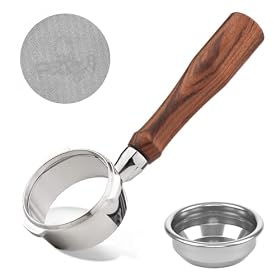
A bottomless portafilter is only useful if it locks into your espresso machine correctly. Check the group size, lug pattern, basket diameter, handle clearance, and compatibility with your machine before buying.
A bottomless portafilter must match your espresso machine’s group size and locking pattern—not just its advertised diameter. Before buying, identify your machine model, confirm the portafilter size, compare the number and position of the locking lugs, and make sure the replacement includes a basket that fits your routine.
What a bottomless portafilter does
A bottomless, or naked, portafilter has no spouts underneath the basket. This gives you a direct view of the espresso as it leaves the puck.
It can help reveal:
Channeling, where water finds weak paths through the coffee
Uneven distribution or tamping
A basket that is overfilled or underfilled
A poor seal between the portafilter and group gasket
Problems with grind size, dose, or puck preparation
It will not correct those problems by itself. It is mainly a diagnostic and workflow accessory, and it can produce more spray or mess when the puck is prepared unevenly.
How to make sure it fits
1. Identify the exact espresso machine
Start with the model name and, if available, the model number. Search for a portafilter described as compatible with that exact machine rather than relying on a generic listing.
Machines from the same brand may use different portafilter sizes or locking designs. Even machines that use the same nominal diameter may differ in lug thickness, lug position, basket depth, or the amount of rotation needed to lock in place.
2. Confirm the group size
Common portafilter diameters include 51 mm, 54 mm, and 58 mm, but the number alone does not guarantee compatibility. Measure the basket or existing portafilter only if you can do so accurately, and treat the measurement as a starting point rather than final proof.
The safest match usually includes all of these details:
The lugs are the tabs that engage with the group head. A portafilter can have the correct diameter but still fail to lock if the lugs are shaped or positioned differently.
If you still have the original portafilter, compare its underside with product photos. Look for the number of lugs, their approximate positions, and their thickness. Do not force a replacement that stops early, feels unusually tight, or requires excessive pressure to lock.
4. Check basket compatibility
Some bottomless portafilters include a single basket, while others include multiple baskets or no basket at all. Confirm whether the included basket is compatible with the portafilter and suitable for your intended dose.
A bottomless portafilter normally works with a standard, non-pressurized basket. If your machine came with a pressurized basket, verify that it accepts the replacement basket size and that you have a grinder capable of producing a suitable espresso grind. The portafilter handle and basket are related, but they are not interchangeable as one universal standard.
5. Check clearance and handle position
A portafilter can technically lock into the machine yet be inconvenient or unusable if the handle hits the drip tray, body, or adjacent equipment. Product photos may not show the handle angle clearly, so check measurements and user documentation when clearance is tight.
Product prices and availability are accurate as of the date/time indicated and are subject to change. Any price and availability information displayed on Amazon.com at the time of purchase will apply to the purchase of this product.
A practical compatibility checklist
Before ordering, confirm:
Exact espresso machine model
Group size listed by the seller
Locking lug count and pattern
Basket diameter and depth
Whether a basket is included
Whether the basket is pressurized or non-pressurized
Handle angle and machine clearance
Return policy in case the fit is incorrect
A listing that says only “fits 58-mm machines” does not provide enough information by itself. Look for a compatibility list or a clear underside photo.
Product prices and availability are accurate as of the date/time indicated and are subject to change. Any price and availability information displayed on Amazon.com at the time of purchase will apply to the purchase of this product.
When a universal bottomless portafilter is a poor choice
Generic portafilters are risky for machines with proprietary group heads, unusual lug patterns, or uncommon basket dimensions. They are also a poor choice when the seller does not identify compatible models or provide useful measurements.
For a machine with a proprietary portafilter, look for a machine-specific replacement or confirm compatibility directly with the manufacturer or an established parts supplier. Some machines may not have a practical bottomless option at all.
Product prices and availability are accurate as of the date/time indicated and are subject to change. Any price and availability information displayed on Amazon.com at the time of purchase will apply to the purchase of this product.
What to expect after installation
Remove the existing portafilter and clean the group area before fitting the new one. Insert the replacement without coffee first and lock it in gently. It should engage smoothly and form a seal without forcing the handle.
Run a short water cycle and check for leaks around the group head. Then test with coffee while keeping your hands and face away from the bottom of the portafilter. Espresso can spray sideways if the puck channels.
Product prices and availability are accurate as of the date/time indicated and are subject to change. Any price and availability information displayed on Amazon.com at the time of purchase will apply to the purchase of this product.
Troubleshooting a poor fit
It will not lock in
Remove it and check that the basket is seated correctly and that no coffee grounds are on the group gasket or portafilter rim. If it still will not lock, the lug pattern or portafilter size is probably wrong. Do not force it.
It locks but leaks
Clean the sealing surfaces and inspect the group gasket for damage or excessive wear. Confirm that the basket rim is seated evenly. If the original portafilter seals correctly but the replacement leaks, the replacement may have an incompatible rim, lug position, or basket.
It locks too far or too loosely
A different locking position can indicate a mismatch or a worn group gasket. Compare the replacement with the original and consult the machine’s instructions. A portafilter that requires unusual force can damage the group-head components over time.
Espresso sprays from the bottom
Spraying usually points to channeling, uneven distribution, an unsuitable grind, or an incorrect dose—not necessarily a defective portafilter. If spraying continues after improving puck preparation, inspect the basket for damage and confirm that it is seated correctly.
Bottom line
Choose a bottomless portafilter by exact machine compatibility first and nominal diameter second. The best listing will identify your machine model, show the locking pattern, specify the basket details, and explain what is included. If those details are missing, a machine-specific replacement with a clear return policy is safer than a generic “universal” option.
FAQ
How do I know what size bottomless portafilter I need?
Check your espresso machine’s manual or search by the exact machine model. Group size alone is not enough because locking lugs, basket dimensions, and lug positions can vary.
Will any 58-mm bottomless portafilter fit a 58-mm espresso machine?
No. Two 58-mm machines can use different lug patterns or basket designs. Confirm the exact machine compatibility rather than buying based only on diameter.
Can I use a bottomless portafilter with a pressurized basket?
Some combinations may physically fit, but bottomless portafilters are generally intended for standard non-pressurized baskets. Confirm the basket and machine compatibility before buying.
Why does my bottomless portafilter spray?
Spraying is commonly caused by channeling from uneven distribution, an unsuitable grind, an incorrect dose, or a damaged basket. It can also result from a poor seal or an incorrectly fitted basket.
Should I buy a bottomless portafilter or a replacement spouted portafilter?
Choose bottomless if you want to diagnose puck preparation and your machine has a confirmed compatible option. Choose a spouted replacement if you prioritize cleaner serving, easier setup, or a machine-specific bottomless option is unavailable.