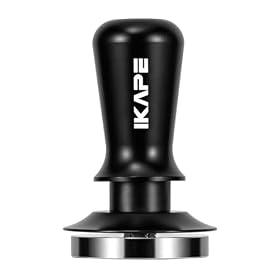
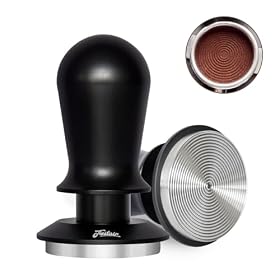
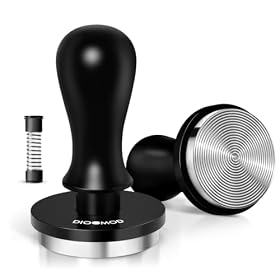
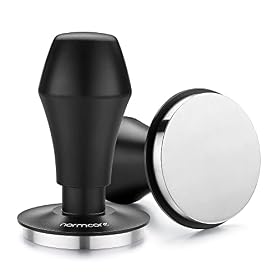
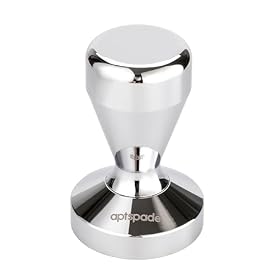
A calibrated tamper only helps if its base matches the basket. Here’s how to check diameter, basket shape, depth, and pressure design before buying.
A calibrated tamper is worth considering if you want more consistent tamping pressure, but fit comes first. The tamper base should sit inside the basket without binding, leaving little enough edge clearance to compress the coffee evenly without scraping the walls. Start with the basket’s actual internal diameter and shape—not just the advertised size of your espresso machine or portafilter.
What “calibrated” means
Most calibrated tampers use a spring or another force-limiting mechanism. When you reach the mechanism’s designed force, the handle may stop, click, or give a noticeable indication. This can make your routine more repeatable, especially if multiple people prepare espresso.
Calibration does not automatically produce a level puck or correct extraction. Grind size, coffee dose, distribution, basket shape, and tamping technique still matter. A calibrated tamper is a consistency aid, not a substitute for dialing in the grinder.
Match the tamper to the basket
Measure the basket’s internal diameter
Look for the basket manufacturer’s compatibility information first. If it is unavailable, measure the inside of the basket near the area where the tamper will compress the coffee. A caliper gives the most useful measurement; measure at more than one point because some baskets are slightly tapered or not perfectly round.
Do not rely only on labels such as “58 mm.” Baskets sold under the same nominal size can have different internal diameters, wall shapes, or usable depths. A tamper that is only slightly too large may bind, while one that is too small can leave a ring of loose coffee around the edge.
Check the basket profile
Basket geometry affects fit as much as diameter. Check whether your basket is:
Straight-sided: Often easier to match with a flat-base tamper.
Tapered: May need a base shape that follows the basket more closely.
Ridged: Has an internal ridge that can limit how far the tamper travels.
Ridgeless: Usually offers a more continuous tamping surface.
Deep or shallow: Determines whether the tamper can reach the coffee without the handle or shoulder contacting the basket.
A tamper base that fits the opening but is too deep can bottom out or hit the basket before compressing the puck. Check the product’s stated base dimensions and compatibility notes, not just its diameter.
Product prices and availability are accurate as of the date/time indicated and are subject to change. Any price and availability information displayed on Amazon.com at the time of purchase will apply to the purchase of this product.
Choose the right base shape
A flat base is the straightforward choice for many standard baskets. It presses the coffee across a broad, level surface and is generally easy to pair with a compatible basket.
A convex base has a curved underside. It may be intended for particular basket designs or personal preferences, but it is not automatically better. If you are replacing a tamper, match the base style recommended for your basket rather than assuming a curved base will improve extraction.
The tamper’s edge or shoulder also matters. Even when the base diameter is correct, a wide shoulder can rub against the basket rim or prevent the tamper from reaching the desired depth.
Product prices and availability are accurate as of the date/time indicated and are subject to change. Any price and availability information displayed on Amazon.com at the time of purchase will apply to the purchase of this product.
Decide whether calibrated pressure is useful
A calibrated model makes the most sense when:
You are learning and want a repeatable stopping point.
More than one person prepares coffee on the machine.
You tend to vary tamping force from shot to shot.
You want a clear routine while improving distribution and grind settings.
A standard fixed tamper may be preferable if you already tamp consistently or want fewer moving parts. Whichever type you choose, prioritize a precise fit and comfortable grip over a claimed pressure number. The correct pressure setting can vary by coffee, dose, basket, and puck-preparation method.
Replacement basket when the current basket is difficult to match
Product prices and availability are accurate as of the date/time indicated and are subject to change. Any price and availability information displayed on Amazon.com at the time of purchase will apply to the purchase of this product.
Check compatibility before ordering
Use this buying checklist:
Identify the basket, not just the machine. A machine can accept different baskets or portafilters, and aftermarket baskets may not share the same dimensions as the original.
Find the internal diameter. Use the basket maker’s fit chart or measure the basket directly.
Confirm the base shape. Check flat versus convex and any guidance for ridged or ridgeless baskets.
Check the base depth and shoulder clearance. The tamper should not bottom out or bind against the basket.
Confirm the calibrated mechanism. Look for how the mechanism signals or limits pressure and whether its adjustment or maintenance requirements suit you.
Verify the return policy. Fit is difficult to judge from a listing photo, especially for baskets with unusual tapering.
If you use more than one basket, check each one separately. A tamper that fits a precision basket may be too loose or too large for the stock basket supplied with the machine.
Common fit problems
The tamper gets stuck
The base is probably too large, the basket is tapered, or the basket is not perfectly round. Stop forcing it, because repeated binding can disturb the puck and may damage the basket edge. Compare the tamper’s measured base diameter with the basket’s internal measurement.
Coffee remains around the edge
The tamper may be undersized, or the basket may have a shape that does not suit that base. A small amount of clearance is normal, but a visible ring of untouched coffee can contribute to uneven extraction. Improve distribution before tamping and consider a closer-fitting tamper or a basket designed for that size.
The tamper does not reach the coffee
Check the dose, basket depth, and tamper shoulder. A ridged or shallow basket can stop the tamper early. A tall dosing funnel, if still attached, can also interfere with the handle or shoulder.
The calibrated mechanism activates inconsistently
Make sure the tamper is sitting level and fully inside the basket. Inconsistent dose height, uneven distribution, or a dirty mechanism can make the indication feel different. Follow the manufacturer’s cleaning and adjustment instructions; do not disassemble a spring mechanism unless the instructions permit it.
What to buy in practical terms
For most home setups, the safest choice is a calibrated tamper specifically listed for your basket’s internal diameter and profile. If the listing gives only a nominal diameter and does not explain basket compatibility, treat that as a fit risk.
Replace the tamper when the base is damaged, the mechanism no longer gives a repeatable indication, or the handle has developed excessive play. If the tamper fits but shots remain inconsistent, investigate distribution, grinder adjustment, dose, and basket condition before assuming the tamper is the cause.
When no compatible calibrated tamper is available, a correctly sized fixed tamper is usually more useful than a poorly fitting calibrated model. A precise fit and level puck matter more than the calibration feature alone.
Use the basket’s internal diameter and its manufacturer’s compatibility information. Do not assume the portafilter’s nominal size is the tamper size, because baskets with the same advertised size can have different internal dimensions and profiles.
Does a calibrated tamper improve espresso extraction?
It can improve repeatability by making tamping force more consistent, but it does not guarantee better extraction. Grind size, distribution, dose, basket design, and freshness still have a larger effect on many shots.
Should I buy a flat or convex espresso tamper?
Choose the base shape recommended for your basket. A flat base is a common general-purpose choice, while a convex base may suit specific basket designs or preferences. Fit and clearance are more important than choosing one shape universally.
Can one tamper fit every basket on my espresso machine?
Not necessarily. Stock, precision, ridged, ridgeless, tapered, and aftermarket baskets can have different internal dimensions. Measure or verify each basket if you use more than one.