A naked portafilter is best treated as a diagnostic tool, not a badge of espresso skill. Because the spouts are removed, you can see how water moves through the coffee puck. A centered, even flow usually suggests reasonably good puck preparation; spraying, spurting, or one-sided flow points to channeling or another preparation problem. It can also make a normal shot look dramatic, so use it to guide changes—not to judge technique by appearance alone.
Accessories · Mon Sep 07
Naked portafilter as a diagnostic not a flex
A naked, or bottomless, portafilter is useful because it exposes the underside of the coffee puck during extraction. Here is how to read the spray pattern, avoid misleading conclusions, and decide whether the issue is grind, dose, distribution, tamping, or the espresso machine itself.
What a naked portafilter shows
A standard portafilter hides the extraction beneath one or two spouts. A naked portafilter exposes the filter basket and the bottom of the puck, allowing you to observe:
- Whether water breaks through weak areas of the puck
- Whether extraction begins on one side or in several isolated spots
- Whether coffee sprays outside the cup
- Whether the flow eventually joins into a relatively smooth stream
- How changes to grinding, dosing, distribution, and tamping affect the shot
The visual result is only evidence. It does not directly tell you that a shot tastes good or bad. Taste, shot volume, timing, and consistency still matter more than a visually attractive stream.
Compatible naked portafilter
 Normcore 54mm Bottomless Portafilter, Naked Portafilter Fits Breville Sage Barista Express Machines, 18g Filter Basket…Normcore
$68.99 as of
View on Amazon KNODOS 54mm Bottomless Portafilter Breville Compatible Rosewood Handle & Naked 18-21 Gram Filter Basket Included…KNODOS
$49.99 as of
View on Amazon Normcore 58mm Naked Portafilter Compatible with all La Marzocco Home Espresso Machines, Bottomless Espresso Portafilter…Normcore
$69.99 as of
View on Amazon
Product prices and availability are accurate as of the date/time indicated and are subject to change. Any price and availability information displayed on Amazon.com at the time of purchase will apply to the purchase of this product.
How to read the extraction
A relatively even flow
After the initial wetting phase, the coffee may begin flowing from several points and then combine into a steady stream. This generally indicates that water is finding reasonably similar resistance throughout the puck.
It is not proof that the shot is perfectly extracted. A shot can look even and still taste sour, bitter, thin, or harsh if the grind, dose, water, or brew ratio is unsuitable.
Spraying or spurting
Fine jets shooting sideways or upward usually indicate channeling: water has found a low-resistance path through the puck. Common causes include:
- Clumps left in the ground coffee
- Uneven distribution in the basket
- A tilted or inconsistent tamp
- Cracks around the puck edge
- A grind that is too coarse for the rest of the setup
- A basket filled too high or too low
Spraying can also result from a damaged basket, a dirty filter, a poorly fitted portafilter, or coffee hitting a surface irregularly. Do not assume every spray is caused by your tamp.
Flow from one side
A one-sided start can suggest an uneven puck, an uneven tamp, or a machine that is not level. It may also be caused by how the coffee was distributed before tamping.
Check the puck preparation first. If the same strong bias remains with careful preparation, inspect the basket and confirm that the machine is sitting level enough for normal operation.
A very fast, pale flow
A fast flow often points to coffee that is too coarse, too little coffee in the basket, or severe channeling. The shot may taste thin or sour, but taste should guide the adjustment more than color alone.
Change one variable at a time. If you make the grind finer, keep the dose and target beverage amount consistent while evaluating the result.
A slow, dark, or stalled flow
A very slow shot can come from a grind that is too fine, too much coffee, excessive compaction, or a blocked basket. It can also happen when the machine is unable to deliver water normally.
If the flow remains restricted after checking the grind and dose, remove the basket and inspect it for blockage. Follow the machine manufacturer’s cleaning instructions rather than forcing water through a clogged group or basket.
Espresso distribution tool
 Apexstone 53mm Coffee Distributor, Espresso Distribution Tool, Coffee Leveler Compatible with Breville 54mm PortafilterApexstone
$17.99 as of
View on Amazon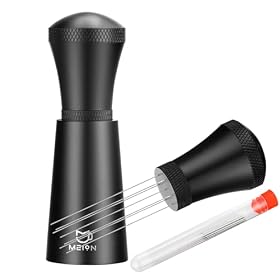 WDT Espresso Distribution Tool Espresso Stirrer Tools for Barista, 0.35mm 7 Needles Espresso Coffee Stirrer…MEION
$16.99 as of
View on Amazon Nessus WDT Espresso Distribution Tool, Espresso Accessories with Built-in Cleaning Brush, 0.35mm 10 Needle Distributor…NESSUS
$9.99 as of
View on Amazon
Product prices and availability are accurate as of the date/time indicated and are subject to change. Any price and availability information displayed on Amazon.com at the time of purchase will apply to the purchase of this product.
A sensible diagnostic sequence
Use the naked portafilter after establishing a repeatable baseline. Keep the coffee, basket, dose, target output, and preparation method as consistent as possible.
1. Check the coffee and grind
Stale coffee can produce less predictable results, but freshness alone does not fix channeling. Confirm that the grinder is producing grounds appropriate for espresso and that the setting has not shifted.
If the shot is consistently too fast, make a small grind adjustment toward finer grounds. If it is consistently too slow, adjust toward coarser grounds. Make only one change at a time.
2. Break up clumps and distribute evenly
Ground coffee can form dense clumps, especially when the grinder produces static or the dose falls unevenly into the basket. Gently distribute the grounds across the basket before tamping. A suitable distribution tool can help, but careful hand distribution is still better than leaving visible piles or hollows.
Avoid aggressively stirring so deep that you scratch the basket or create a loose layer at the bottom.
3. Tamp level and consistently
Tamp straight down with enough pressure to consolidate the coffee. The exact force is less important than keeping the tamper level and repeating the same motion.
A tilted tamp creates a puck with uneven resistance. Do not try to correct a bad extraction by tamping harder and harder; excessive force is rarely the main solution.
4. Check dose and headspace
Use the basket size recommended for your portafilter and machine. Too much coffee can press against the shower screen, while too little may leave an unusually thin puck that channels easily.
The correct dose depends on the basket and the machine, so follow the basket or machine manufacturer’s guidance rather than copying a number from a different setup.
5. Inspect the basket and portafilter
Remove coffee residue and confirm that the basket holes are open. Check that the basket sits securely in the portafilter and that the portafilter locks into the group head normally.
A naked portafilter should be compatible with your machine’s group-head size, locking tabs, basket style, and portafilter depth. Compatibility listings should be checked carefully before purchase.
Replacement espresso basket
 51mm Bottomless Portafilter 3 Ears Compatible with CASABREWS CM5418 and 3700 Series | with Stainless…CAPFEI
$24.99 as of
View on Amazon- KNODOS 54mm Bottomless Portafilter Breville Compatible Rosewood Handle & Naked 18-21 Gram Filter Basket Included…KNODOS
$49.99 as of
View on Amazon  58mm E61 Precision Filter Ridged Basket Stainless Steel Portafilter Basket Espresso Compatible 58MM Portafilter FilterBasket…Joytata
$18.45 as of
View on Amazon
Product prices and availability are accurate as of the date/time indicated and are subject to change. Any price and availability information displayed on Amazon.com at the time of purchase will apply to the purchase of this product.
Using it without making a mess
Naked portafilters can spray coffee, particularly while you are correcting channeling. Place a sufficiently wide cup under the basket and keep your hands, face, and clothing away from the extraction area. Hot water and espresso can cause burns.
A bottomless portafilter is easier to use when the machine is on a stable surface and the cup is centered. Clean the portafilter after each use so dried coffee oils do not affect later shots.
Do not put fingers under the basket during or immediately after brewing. Follow the machine manufacturer’s instructions for removing the portafilter, releasing pressure, and cleaning the group head.
What it cannot diagnose by itself
A naked portafilter cannot reliably tell you:
- Whether the espresso tastes balanced
- Whether the brew temperature is correct
- Whether the machine’s pressure system is operating normally
- Whether the coffee is fresh enough for your preference
- Whether a change improved the shot unless you taste the result
If extraction looks uneven and tastes poor, begin with puck preparation and grind adjustment. If shots remain inconsistent despite repeatable preparation, investigate the grinder, basket, machine cleanliness, and water delivery.
When to stop adjusting technique
Replace or repair the relevant part when the problem follows the equipment rather than your preparation. Examples include a basket with damaged or blocked holes, a portafilter that does not lock securely, or a grinder that produces visibly inconsistent grounds despite normal cleaning and adjustment.
If the machine leaks, makes unusual electrical noises, repeatedly loses pressure, or behaves unpredictably, stop using it and consult the manufacturer or a qualified espresso-machine technician. Do not open or modify electrical or pressurized components unless you are qualified and the manufacturer permits that work.
A naked portafilter is worthwhile when you want direct feedback while learning distribution and grind adjustment. It is less useful as a permanent performance test if watching the flow makes you change several variables at once. Use it briefly, make controlled adjustments, and let the flavor in the cup make the final decision.
FAQ
Is a naked portafilter better than a regular portafilter?
Neither is universally better. A naked portafilter exposes channeling and puck-preparation problems, while a spouted portafilter is usually cleaner and more forgiving for serving espresso. Many home users keep both for different purposes.
Why does my naked portafilter spray everywhere?
Spraying commonly results from channeling caused by clumps, uneven distribution, a tilted tamp, an unsuitable grind, or an incorrect dose. A blocked or damaged basket and poor portafilter compatibility can also contribute.
Can a naked portafilter improve espresso taste?
It does not improve the coffee by itself. It can help you identify preparation problems, allowing you to make better grind, dose, distribution, and tamping adjustments.
Do I need a naked portafilter to make good espresso?
No. A standard spouted portafilter can make excellent espresso. A naked portafilter is an optional learning and troubleshooting accessory, not a requirement.