Hard water can damage an espresso machine boiler by leaving calcium and magnesium deposits on its internal surfaces. That mineral buildup—usually called scale—acts as insulation, restricts water flow, interferes with valves and heating elements, and can eventually contribute to leaks or component failure. The damage is gradual, so prevention is usually much easier and cheaper than repairing a heavily scaled machine.
Maintenance · Mon Sep 07
How Hard Water Destroys an Espresso Machine Boiler
Hard water leaves mineral scale inside an espresso machine boiler. Over time, that scale reduces heating efficiency, restricts valves and passages, affects pressure and temperature, and can turn a routine cleaning problem into a costly repair.
What hard water does inside a boiler
When water is heated, dissolved minerals can come out of solution and attach to hot surfaces. In an espresso machine, those surfaces may include the boiler walls, heating element, water inlet, outlet passages, valves, and probes.
A thin mineral film may not cause an immediate problem. As it thickens, it can create several issues:
- Reduced heating efficiency: Scale around a heating element acts as insulation. The machine may take longer to heat or cycle more often.
- Restricted water flow: Deposits can narrow small passages, jets, and valve openings.
- Temperature instability: A scaled heating system or obstructed temperature probe may make temperature control less consistent.
- Pressure and steam problems: Restricted flow or a poorly sealing valve can affect brewing pressure or reduce steam performance.
- Leaks: Mineral deposits can prevent valves, fittings, and seals from closing correctly. They may also mask or worsen damage around connections.
- Premature component failure: Pumps, solenoid valves, heating elements, and control components may be forced to work under less favorable conditions.
Scale does not usually destroy a boiler overnight. It is a maintenance problem that becomes more serious with continued use, especially when the machine is filled with untreated hard water.
Machine-compatible descaler
 Breville Espresso Machine Compatible Descaler, 4 Uses, 1 Year Supply, 16 ozTillbrook
$12.99 as of
View on Amazon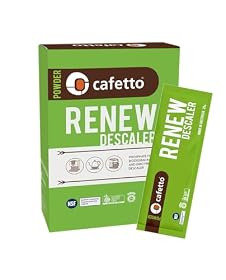 verybarista Renew Descaler (6 x 25g sachets). Designed for espresso machines, boilers and coffee brewers.…verybarista
$15.99 as of
View on Amazon ACTIVE Coffee Machine Descaler Descaling Solution - 32oz (8 Uses) Compatible with Keurig,Nespresso,Breville,Delonghi, Jura, Ninja…ACTIVE
$23.61 as of
View on Amazon
Product prices and availability are accurate as of the date/time indicated and are subject to change. Any price and availability information displayed on Amazon.com at the time of purchase will apply to the purchase of this product.
Why espresso machines are especially vulnerable
Espresso machines repeatedly heat relatively small amounts of water to high temperatures. The hottest internal surfaces are where mineral deposits can form most readily. Machines with boilers, thermoblocks, or thermocoils can all be affected, although the exact symptoms and service procedure vary by design.
A machine that produces steam has additional hot-water pathways and valves where scale can accumulate. Dual-boiler and heat-exchanger machines may also have more than one water circuit to maintain, while a single-boiler machine may show changes in both brewing and steaming performance as buildup increases.
The machine's construction does not make it immune to hard water. Stainless steel, brass, aluminum, and other materials can all be affected by mineral deposits, though the recommended cleaning chemicals and procedures may differ.
Reservoir water filter
 Possiave 12-Pack Water Filters Compatible with Breville BWF100 Machinespossiave
$15.99 as of
View on Amazon Water Filter Replacement for Breville Espresso Machine Barista Touch BES880isinlive
$25.99 as of
View on Amazon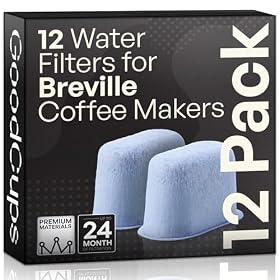 12 Water Filters for Breville BWF100 Machines - Replacement Charcoal Filters for Breville Coffee MakersGoodCups
$11.95 as of
View on Amazon
Product prices and availability are accurate as of the date/time indicated and are subject to change. Any price and availability information displayed on Amazon.com at the time of purchase will apply to the purchase of this product.
Warning signs of boiler scale
Look for a combination of symptoms rather than relying on one sign alone:
- Longer-than-usual heat-up time
- Weak or inconsistent steam
- Reduced water flow from the group head or hot-water outlet
- A pump that sounds different or runs longer than expected
- Flakes or grit in the water
- A leaking or noisy solenoid valve
- Water around boiler fittings or other connections
- Unstable brew temperature
- The machine repeatedly showing a fill, heat, or water-level fault
These symptoms can also come from a clogged screen, blocked filter, failing pump, airlock, faulty temperature sensor, or worn seal. Do not assume every performance problem is caused by scale.
Water hardness testing
 Hard Water Test Strip for Breville Oracle, Oracle Touch, Barista Touch, Barista Express BES920XL BES900XL…Aquadur
$6.70 as of
View on Amazon Delonghi 5532110300 Water Test StripDe'Longhi
$6.90 as of
View on Amazon MacMaxe Hard Water Test Strip for Breville Oracle, Barista Touch, Barista Express BES920XL BES900XL BES980XL…MacMaxe
$7.38 as of
View on Amazon
Product prices and availability are accurate as of the date/time indicated and are subject to change. Any price and availability information displayed on Amazon.com at the time of purchase will apply to the purchase of this product.
How to reduce hard-water damage
Check your water first
Use the water guidance in the espresso machine's manual. If the manufacturer specifies a hardness range or a particular type of filtered water, follow that recommendation rather than choosing water solely by taste.
A water-hardness test strip can help identify whether your tap water is soft, moderately hard, or very hard. Local water reports can provide a starting point, but the water at your home may differ from the utility's average, particularly if you have a private well or a water softener.
Use an appropriate filter or water treatment method
A reservoir filter may reduce some minerals, but its effectiveness depends on the filter type, water chemistry, and replacement schedule. Some machines accept a manufacturer-approved in-tank filter; others require a different treatment approach.
Avoid assuming that bottled water is automatically safe for an espresso machine. Mineral content varies widely between brands, and distilled or very low-mineral water may not be suitable for every machine. Some machines require a minimum mineral content for reliable sensing or operation. Check the manual before changing water types.
Descale on the manufacturer's schedule
Descaling dissolves mineral deposits with an approved chemical solution. The right frequency depends on water hardness, machine design, usage, and whether filtration is used. A machine with a scale alert may estimate service timing, but that alert is not a substitute for following the manufacturer's maintenance instructions.
Use only a descaler compatible with the machine. Follow the stated dilution, soaking time, rinsing procedure, and water-tank instructions. Never mix descaler with other cleaning chemicals.
Backflushing with espresso machine cleaner is a separate task. It removes coffee oils from the brew path, but it does not replace descaling the water circuit and boiler.
Can descaling repair a scaled boiler?
Descaling can remove loose or moderate mineral buildup, but it is not guaranteed to restore a severely neglected machine. A large amount of loosened scale may move into a valve or narrow passage, and aggressive or repeated descaling can expose weakened seals or fittings.
Stop and consult the manufacturer or a qualified espresso machine technician if:
- The machine leaks from the boiler or a fitting.
- A heating fault, electrical fault, or burning smell appears.
- The boiler does not heat or the machine trips a breaker.
- Water flow remains restricted after the approved maintenance procedure.
- Large flakes continue appearing after descaling and thorough rinsing.
- The manual says the boiler must be opened or serviced internally.
Unplug the machine and let it cool completely before removing panels or attempting any internal work. Boiler systems can contain hot water, steam, pressure, and mains voltage. Internal boiler repairs are generally not a suitable do-it-yourself task unless you have the required training and the manufacturer explicitly supports the procedure.
When replacement is more reasonable than repair
Repair may make sense when the machine is otherwise in good condition and the problem is limited to a replaceable valve, seal, probe, or heating element. Replacement becomes more reasonable when the boiler, fittings, pump, control board, and other major parts have all been affected—or when the repair cost approaches the value of the machine.
Before deciding, ask a service center for a diagnosis and an estimate. A machine that only needs routine descaling should not be treated the same as one with a leaking or electrically damaged boiler.
A practical maintenance routine
- Check your home's water hardness or use a water-hardness test strip.
- Confirm the water type and filter requirements in the machine manual.
- Replace reservoir filters at the recommended interval.
- Descale only with a compatible product and the correct procedure.
- Rinse the tank and water circuit thoroughly after descaling.
- Clean the group screen, portafilter, steam wand, and other coffee-contact parts separately.
- Investigate slower heating, weak steam, restricted flow, or leaks early.
- Keep records of filter changes and descaling so maintenance is not based on guesswork.
The best protection is not waiting for visible flakes or a heating fault. Matching the water to the machine and maintaining it on a sensible schedule prevents a gradual mineral problem from becoming boiler damage.
FAQ
Can hard water permanently damage an espresso machine boiler?
Yes. Continued scale buildup can reduce heating efficiency, restrict water passages, interfere with valves and sensors, and contribute to leaks or failed components. The severity depends on water hardness, machine design, usage, and maintenance.
Does filtered water prevent boiler scale completely?
Not necessarily. A filter may reduce scale-forming minerals, but its effectiveness depends on the filter and the water. It must also be replaced on schedule. Follow the espresso machine manufacturer's water recommendations.
Is bottled water better for an espresso machine?
Not automatically. Bottled water can have widely varying mineral content, and very low-mineral or distilled water may not be suitable for every machine. Check the manual and the water's mineral information before using it regularly.
Is descaling the same as backflushing?
No. Descaling removes mineral deposits from the water circuit and heating system. Backflushing cleans coffee oils from the brew path. Most espresso machines need both types of maintenance, performed according to the manufacturer's instructions.
How often should an espresso machine be descaled?
There is no single interval for every machine. Follow the manufacturer's schedule and adjust for water hardness, usage, and filtration. A water-hardness test and a maintenance log can help determine whether your current schedule is appropriate.